
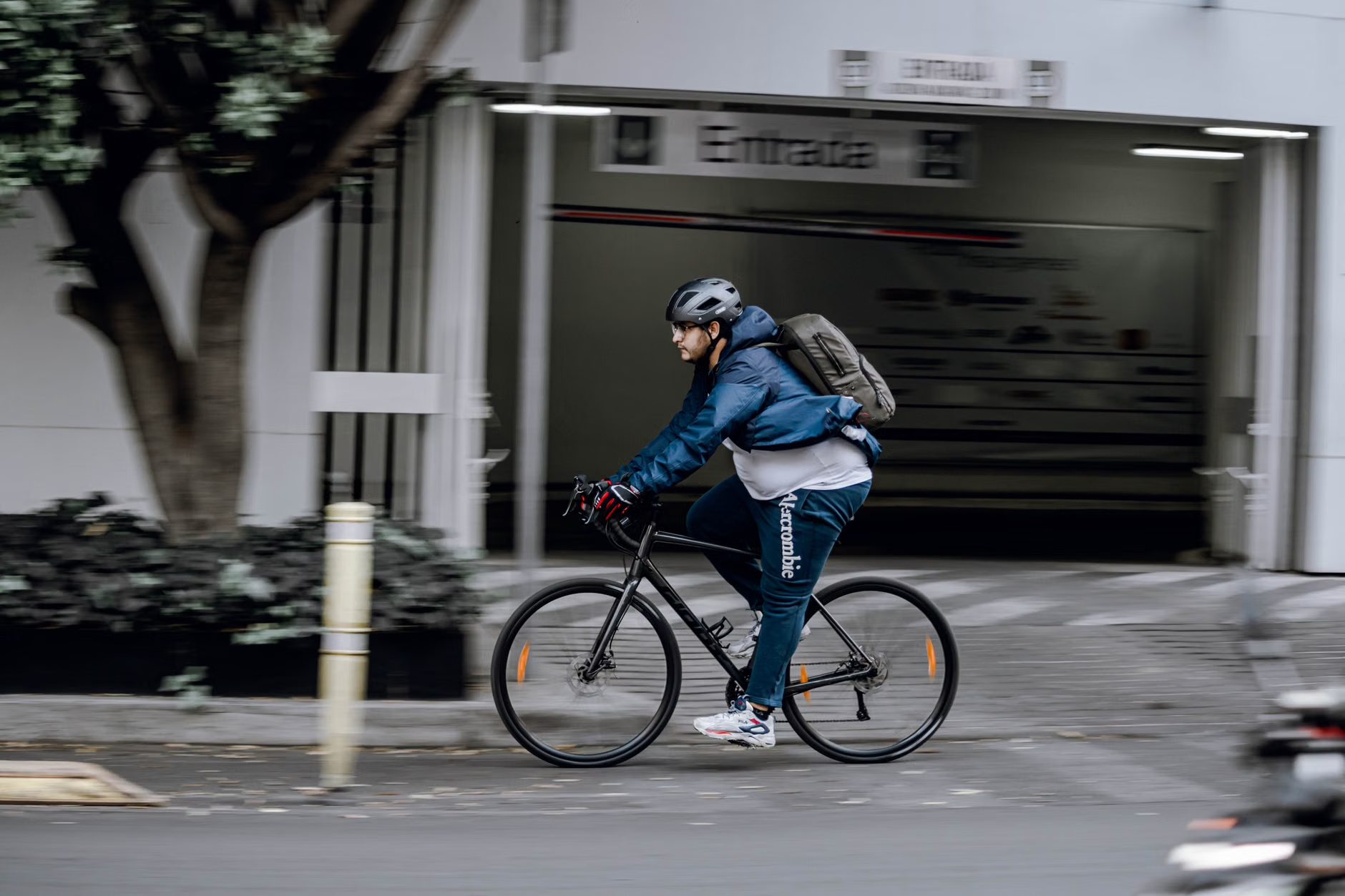
Bike commuting can save surprisingly little or surprisingly a lot, and the difference usually has less to do with the bike itself than with the costs it actually replaces. If riding to work only trims a few car miles while the same loan payment, insurance bill, and parking habit stay in place, annual savings may land in the hundreds. If it replaces paid parking, tolls, a transit pass, or even a second household car, the number can rise into the low thousands or beyond.
That wide range makes sense once you separate per-mile vehicle expenses from the larger annual cost of owning a car at all. AAA’s 2025 Your Driving Costs figures show exactly why this matters: operating costs and ownership costs are different buckets, and bike commuting does not erase both automatically. (newsroom.aaa.com)
The first question is not bike or car. It is which costs actually disappear.
Most people start with fuel because it is visible and easy to imagine. But fuel is only one part of commute cost. AAA’s 2025 breakdown separates operating expenses such as fuel, maintenance, and tires from ownership expenses such as depreciation, finance charges, insurance, licensing, registration, and taxes. For a new vehicle, the weighted-average operating cost was 24.03 cents per mile, while annual ownership cost alone was $7,973. Total cost at 15,000 miles a year came to $11,577, or 77.18 cents per mile. (newsroom.aaa.com)
That does not mean every bike mile saves 77 cents. It means the real answer depends on whether commuting by bike merely replaces some miles or changes the household’s car situation. A rider who keeps the same car, drives it on weekends, and still pays for a reserved garage space is mostly saving variable costs. A rider who can stop paying for work parking, cancel a transit pass, or avoid buying a second car is attacking much larger line items. That is the difference between modest savings and meaningful budget change.

Use the Replacement Ladder before you trust any savings estimate
A useful way to think about bike commuting is the Replacement Ladder, an editorial framework for separating small savings from big ones. Each rung asks a different question: Are you replacing miles? Are you replacing trip-specific fees? Or are you replacing a whole vehicle decision? The higher the rung, the more powerful the savings usually become.
- Rung 1: Replace miles. You save fuel or electricity, some maintenance, tire wear, and part of mileage-related depreciation.
- Rung 2: Replace trip fees. You may also remove parking charges, tolls, or out-of-pocket transit fares on bike days.
- Rung 3: Replace a vehicle decision. Consistent bike commuting can help a household postpone a purchase, avoid a second car, or downsize how much vehicle it needs to own.
| What your bike commute replaces | Costs that usually disappear right away | Costs that may still stay in place | How to estimate annual savings |
|---|---|---|---|
| Some driving miles, but you keep the car | Fuel or charging, part of maintenance, tire wear, some mileage-related depreciation | Loan or lease, most insurance, registration, much of ownership cost | Bike-commute miles avoided × your car’s operating cost per mile |
| Driving plus parking or tolls | Everything above, plus parking and tolls on bike days | Most fixed car costs if the car stays in the household | (Miles avoided × operating cost) + parking + tolls |
| Transit trips | Out-of-pocket fares or the share of a pass you truly stop buying | Employer-subsidized value, occasional backup trips | Bike days × actual out-of-pocket fare or pass share |
| A second household car | Potentially a large share of insurance, registration, depreciation, finance, maintenance, and parking | Primary-car costs and occasional rentals or car-share | Add the annual fixed costs you truly eliminate, not the ones you merely postpone |
The table also explains why people talk past each other on this subject. Someone in a suburb with free parking and a paid-off car may honestly save only a few hundred dollars a year. Someone who stops paying downtown parking or helps a household live with one fewer car may save several times that. Both stories can be true because they are not replacing the same costs.
What the math looks like in practice
Start with a modest case. Suppose a commuter replaces a 12-mile round trip three days a week for 46 weeks of the year. That is about 1,656 car miles avoided. Using AAA’s 2025 weighted-average operating-cost figure of 24.03 cents per mile, the gross savings are about $398 before bike-side costs. That is real money, but it is not life-changing if nothing else changes. (newsroom.aaa.com)
Now take a stronger example. Suppose a commuter replaces a 14-mile round trip five days a week for 46 weeks, or about 3,220 miles a year. At 24.03 cents per mile, that removes about $774 in vehicle operating cost. If the same rider also stops paying $8 a day for parking over 230 workdays, the parking savings add $1,840. Gross annual savings jump to roughly $2,614 before bike expenses. In that scenario, parking matters more than fuel. (newsroom.aaa.com)
If the replaced vehicle is an EV, the savings per mile may be smaller, but they do not disappear. AAA’s 2025 fact sheet listed EV operating cost at 15.13 cents per mile, below the weighted average across new vehicles. The U.S. Department of Energy also notes that EV cost per mile depends on local electricity prices and the vehicle’s efficiency, which means an EV owner can calculate a more personalized number directly from utility bills and the car’s kWh-per-100-mile rating. Parking, tolls, and ownership decisions still matter regardless of powertrain. (newsroom.aaa.com)
The biggest jump happens when bike commuting changes a car ownership decision. AAA’s 2025 fact sheet put the weighted-average annual ownership cost of a new vehicle at $7,973, separate from operating expenses. A household that genuinely eliminates a car will not necessarily save that exact amount, because its real alternative may be a used hatchback, a financed SUV, or a company vehicle. Still, the figure makes the budget logic clear: the largest savings usually come from avoiding ownership costs, not from skipping a few fill-ups. (newsroom.aaa.com)
How to calculate your own number in 20 minutes
- Count realistic bike-able workdays, not ideal ones. Subtract remote-work days, vacation, common weather disruptions, and days when carrying heavy gear or doing school pickup makes riding unlikely.
- Measure your normal round-trip commute distance. For mixed-mode commuting, count only the miles or fares the bike will actually replace.
- Identify what mode you are replacing most often: a gas car, hybrid, EV, transit, rideshare, or some combination.
- Calculate the costs that vanish on bike days. For drivers, that usually means operating cost per mile plus any parking and tolls. For transit users, it means actual out-of-pocket fare or the part of a pass you stop buying.
- Separate the costs that only disappear if your household truly changes its vehicle setup, such as insurance on a second car, registration, financing, or leased parking.
- Subtract the bike-side ledger: the bike itself, lock, lights, helmet, storage, repairs, clothing, and backup transportation when riding is not practical.
- Check the estimate again after 60 to 90 days. A good forecast becomes much better once you know how often you really ride.
If you do not track car costs closely, AAA’s operating-cost figure is a reasonable planning baseline for a new vehicle, while EV owners can use DOE’s electricity-cost method to build a more personalized estimate. Do not start with the full vehicle ownership figure unless bike commuting is likely to change whether the household owns that car at all. (newsroom.aaa.com)
Do not forget the bike-side ledger
A bike commute is not free, and pretending it is will make the savings estimate look better than reality. The cleaner comparison is annual cost versus annual cost. Spread the bike and essential gear over the years you expect to use them, then add the recurring expenses that daily riding creates. The total is still usually much smaller than car ownership, but it should be counted honestly.
- The bike itself, amortized over its useful life rather than counted all at once
- Helmet, lights, lock, reflective gear, and basic security accessories
- Panniers, rack, fenders, rain layers, and seasonal clothing or tires if your climate requires them
- Routine maintenance such as tires, tubes, brake pads, chain wear, tune-ups, and drivetrain replacement over time
- Secure storage at home or work, plus occasional transit or rideshare backup for bad-weather days
- For e-bikes, add charging, a reserve for eventual battery replacement, and possibly faster wear on some consumables
This subtraction matters most for part-time riders. If someone bikes once a week but buys a high-cost commuter setup and still keeps every car expense unchanged, the net savings may take a while to show up. By contrast, a practical used bike or a straightforward commuter e-bike used several days a week often improves the economics more quickly because the fixed bike investment is spread over many replaced trips.

Where people overestimate or underestimate the savings
The most common underestimate is gas-only math. AAA’s operating-cost figure already shows why that is incomplete: tires, maintenance, and other wear-related costs add up alongside fuel or electricity. A rider who avoids thousands of commute miles in a year is not just saving on energy. The car is also consuming fewer tires, fewer service intervals, and less mileage-related value. (newsroom.aaa.com)
The most common overestimate is assuming every avoided commute mile erases the full cost of owning a car. It usually does not. If the car remains in the driveway, most ownership costs still exist. Another overestimate comes from tax confusion. Daily travel from home to a regular workplace is generally a personal commuting expense under IRS Publication 463, so the savings calculation should not assume some hidden federal deduction is waiting in the background. (irs.gov)
Another place estimates go wrong is consistency. Hybrid work can reduce potential savings because there are simply fewer commute days to replace. Weather, darkness, workplace dress expectations, cargo needs, and childcare stops can also turn a theoretically bike-able route into an occasional one. A realistic calculation should include backup costs rather than assuming perfect year-round riding.
When commuting by bike saves the most
- The commute includes paid parking, tolls, or expensive out-of-pocket transit spending.
- The household is already close to living with one fewer car, or delaying the next replacement purchase.
- The trip length is manageable by regular bike or e-bike several days a week.
- The workplace has secure bike parking, a place to change, or a dress code flexible enough to avoid extra hassle costs.
- The route is low-stress enough that riding can become routine rather than aspirational.

When the savings may be smaller than expected
Time still matters. The U.S. Census Bureau reported a mean one-way commute time of 27.2 minutes in 2024. A bike commute can be financially worthwhile even if it is somewhat slower than driving, but not if the route is so long, complex, or stressful that it only happens occasionally. Savings rely on repeatability. A route that works twice in spring and then sits unused is not a savings strategy. (census.gov)
Savings can also shrink when the bike trip creates offsetting costs. That might mean frequent ride-hail backups, still paying for a monthly garage lease, keeping a nonrefundable transit pass, or buying lots of specialty gear for a route that is rarely ridden. For some workers, especially those with long suburban commutes, heavy cargo, or rigid schedule constraints, the economics may improve only after adding an e-bike, using mixed-mode transit, or riding part of the week instead of forcing an all-or-nothing plan.

Money should not be the only filter. NHTSA says bicyclists on the roadway have the same rights and responsibilities as motorists, and it reported 1,103 bicyclists killed in traffic crashes in 2024. Route quality, visibility, helmet fit, lights, and defensive riding all affect whether the commute is sustainable in practice. Local laws on helmets, sidewalk riding, lane use, and e-bikes also vary. (nhtsa.gov)
A practical rule of thumb
As a rough planning rule, keeping the same car and merely replacing some commute miles usually points to savings in the hundreds of dollars a year. Add paid parking or tolls and the number often moves into the low thousands surprisingly fast. If regular bike commuting lets a household avoid buying, financing, insuring, or storing another car, the savings can rise by several thousand dollars a year. That is an editorial interpretation rather than a national average, but it follows directly from AAA’s large gap between per-mile operating costs and annual ownership costs. (newsroom.aaa.com)
The real value is not just cheaper miles. It is a different transportation budget.
For many commuters, riding a bike will not erase the cost of car ownership overnight. But that is not the right standard. Even part-time commuting by bike can cut operating costs, remove parking expenses, and test whether a household really needs as much car as it currently carries. The smartest next step is simple: calculate one year of realistic bike-able commute days, add the costs that truly disappear, subtract the bike-side ledger, and see which rung of the Replacement Ladder you actually reach. That answer is far more useful than any generic claim that biking is either cheap or not worth it.
FAQ
Is bike commuting still cheaper if my alternative is an EV?
Usually yes, but the gap may be smaller if parking is free and the household keeps the same vehicle either way. AAA’s 2025 figures listed EV operating cost at 15.13 cents per mile, below the 24.03-cent weighted average across new vehicles, and DOE notes that EV cost per mile depends on local electricity rates and vehicle efficiency. Parking, tolls, and ownership costs still matter more than powertrain alone. (newsroom.aaa.com)
How should I count the cost of the bike itself?
Treat the bike like a multi-year commuting tool, not a one-month expense. Spread the purchase and core gear across the years you realistically expect to use them, then add annual maintenance and consumables. That gives you a fair annual number to compare against annual car or transit costs.
Do I save money if I ride only one or two days a week?
Often yes, but usually on the first rung of the Replacement Ladder. The savings tend to come from reduced operating cost and any parking or tolls you avoid, not from changing household car ownership. Part-time riding can still be worthwhile, especially if each bike day displaces an expensive parking day.
Can I deduct bike commuting on my taxes?
Generally no. IRS Publication 463 says daily transportation between home and a regular workplace is generally a nondeductible commuting expense. IRS Publication 15-B also says the federal exclusion for qualified bicycle commuting reimbursements has been eliminated for tax years beginning after 2025, so any employer support should be checked carefully for payroll and tax treatment. (irs.gov)
What if I need transit or rideshare backup sometimes?
Include it in the math. A realistic savings estimate should subtract the share of transit passes, occasional ride-hail trips, or bad-weather parking you will still buy. If the commute only works in perfect conditions, the savings projection is too optimistic.
References
- AAA Your Driving Costs fact sheet (2025) – https://newsroom.aaa.com/wp-content/uploads/2025/09/UPDATE-AAA-Fact-Sheet-Your-Driving-Cost-9.2025-1.pdf
- AAA Newsroom: New Vehicle Costs Drop to $11,577 – https://newsroom.aaa.com/2025/09/aaa-new-vehicle-costs-drop-to-11577/
- U.S. Department of Energy, Alternative Fuels Data Center: Charging Electric Vehicles at Home – https://afdc.energy.gov/fuels/electricity-charging-home?os=av
- IRS Publication 463: Travel, Gift, and Car Expenses – https://www.irs.gov/publications/p463
- IRS Publication 15-B: Employer’s Tax Guide to Fringe Benefits – https://www.irs.gov/publications/p15b
- U.S. Census Bureau: United States Commuting At A Glance – https://www.census.gov/topics/employment/commuting/guidance/acs-1yr.html
- NHTSA: Bicycle Safety – https://www.nhtsa.gov/road-safety/bicycle-safety
