If daily commuting is the goal, neither bike wins by default. A regular bike is usually better when the route is short, fairly flat, safe enough to feel manageable, and the extra effort feels like a benefit. An e-bike usually becomes the better choice when the commute has more friction: distance, hills, wind, work clothes, cargo, limited time, or the need to arrive without a full sweat session. The better commuter is the one you will actually ride on an average Tuesday, not the one that sounds toughest or most virtuous.
Table of Contents
- TL;DR
- The better commuter is the bike that removes the most daily friction
- Run the commute-friction test before you shop
- When a regular bike is the smarter daily tool
- When an e-bike earns its extra complexity
- Why the fitness argument is more nuanced than it sounds
- Safety depends heavily on the route, not just the bike
- Storage, charging, and theft can settle the debate
- Common mistakes that lead to the wrong choice
- A practical way to choose this week
- Frequently Asked Questions
- References
TL;DR
- Choose a regular bike when the commute is already practical without assist and you want more exercise from each mile. Conventional cycling usually produces higher intensity than e-cycling. (pmc.ncbi.nlm.nih.gov)
- Choose an e-bike when the route’s daily friction is what would stop regular riding: longer distance, hills, headwinds, stop-start traffic, or the need to arrive fresher. (pmc.ncbi.nlm.nih.gov)
- Route safety can matter more than bike type. NHTSA recommends lower-traffic, lower-speed routes when possible, and FHWA points to the value of separated bike lanes. (nhtsa.gov)
- If you buy an e-bike, battery and charging habits are part of the commuting decision. CPSC advises using only batteries approved for the device and avoiding modified packs. (cpsc.gov)
The better commuter is the bike that removes the most daily friction
Research on e-cycling points to the same practical theme again and again: electrical assist matters most when distance, hills, or discomfort would otherwise reduce riding frequency, while conventional bikes still ask more from each mile. That is why the real question is not which bike is superior, but which bike makes your route repeatable. (pmc.ncbi.nlm.nih.gov)
Run the commute-friction test before you shop
This is an editorial decision tool, not a scientific scoring system. But it is useful because it keeps the comparison grounded in the actual trip rather than in identity, marketing, or wishful thinking. Count how many of these factors are genuinely hard on your current or planned route.
- Distance and time cushion: If the trip is short enough that a slower day still gets you there comfortably, a regular bike stays attractive. If every extra few minutes threatens a late arrival, assist starts to matter because it helps flatten the bad days, not just the good ones. (pmc.ncbi.nlm.nih.gov)
- Terrain and headwinds: Hills, bridges, exposed waterfronts, and repeated stop-start intersections make effort spike. That is where electric assist earns its keep fastest. (pmc.ncbi.nlm.nih.gov)
- Arrival condition: If you need to show up in office clothes, recover quickly, or avoid arriving overheated, that is a real commuting constraint, not a vanity issue. (pmc.ncbi.nlm.nih.gov)
- Cargo and chained errands: A laptop, lock, lunch, groceries after work, or frequent stops add friction even when the route looks short on paper. Assist is most useful when momentum gets interrupted over and over.
- Storage, charging, and security: A bike you cannot park securely or charge realistically is not a good commuter, no matter how nice it rides. CPSC’s battery guidance is a reminder that the ownership routine matters too. (cpsc.gov)
A simple reading of the test works well in practice. If only zero or one factors are high-friction, start by taking regular bikes seriously. If two or three are high-friction, either type could work and a test ride matters. If four or more are consistently high-friction, the e-bike usually has the daily commuting advantage.
When a regular bike is the smarter daily tool
A regular bike is often the better commuter when the route is already easy enough that consistency is not in question. On a short, reasonably flat trip, the non-assisted bike gives more physical work per mile, keeps the routine mechanically simpler, and lets the commute double as exercise with no decisions about charging or assist levels. Since adults are advised to get at least 150 minutes of moderate-intensity physical activity per week, those extra everyday efforts can matter. Conventional cycling also tends to produce higher exercise intensity than e-cycling. (cdc.gov)
- The route is short enough that a slow day is still fine. (pmc.ncbi.nlm.nih.gov)
- Hills, wind, and repeated stoplights do not turn the ride into a grind. (pmc.ncbi.nlm.nih.gov)
- Charging would add more hassle than real value. (cpsc.gov)
- A major reason for commuting by bike is to build activity into the week. (cdc.gov)
The weakness of the regular-bike answer is not effort itself. It is variability. A commute that feels fine in mild weather can feel very different in summer heat, headwinds, heavy work gear, or a week of tired legs. If those ordinary conditions regularly push the ride from “pleasantly active” to “I’ll just drive,” the regular bike stops being the more disciplined option and starts being the less useful one. That is an editorial judgment, but it lines up with research showing that e-bikes can lower barriers related to hills, distance, and perceived exertion. (pmc.ncbi.nlm.nih.gov)
When an e-bike earns its extra complexity
An e-bike becomes the better commuting tool when the obstacle is not willingness to ride at all, but willingness to ride this specific route, this often. Assist helps flatten hills, blunt headwinds, smooth stop-start traffic, and reduce the sweat penalty of business clothes or a longer trip. Studies on e-cycling suggest it can still deliver meaningful physical activity while making routes feel more achievable for riders who might otherwise skip the bike. For federal consumer product purposes, CPSC defines a low-speed e-bike as a pedal-equipped two- or three-wheeler with a motor under 750 watts and a top speed under 20 mph on motor power alone, but access rules for paths, campuses, trails, and private properties are not universal, so checking before purchase still matters. (pmc.ncbi.nlm.nih.gov)
| Factor | Regular bike leans better when… | E-bike leans better when… | Why it matters |
|---|---|---|---|
| Route time | You can absorb a slower ride without being late. | Commute time is tight and consistency matters more than maximum workout. | Assist helps normalize tougher days and lowers perceived effort. (pmc.ncbi.nlm.nih.gov) |
| Terrain and wind | The route is mostly flat and protected. | Hills, bridges, headwinds, or repeated starts make effort spike. | Electrical assist is most valuable where the route punishes momentum loss. (pmc.ncbi.nlm.nih.gov) |
| Arrival condition | Changing clothes or cooling down is easy. | You need to arrive ready to work with minimal recovery time. | Sweat tolerance is a logistics issue, not a moral one. (pmc.ncbi.nlm.nih.gov) |
| Fitness goal | You want more exertion from each mile. | You want to ride more often and would otherwise drive more often. | E-bikes usually lower intensity per mile but can still provide meaningful activity. (pubmed.ncbi.nlm.nih.gov) |
| Work gear and errands | You travel light and ride directly home. | Your commute includes a heavier bag or routine stops after work. | Cargo turns easy routes into harder ones, especially on starts and climbs. |
| Storage and charging | You want the simplest routine with the fewest extra systems. | You have secure parking and a realistic battery routine. | Battery care and parking logistics can decide whether an e-bike stays convenient. (cpsc.gov) |
The pattern is clear: what pushes people toward e-bikes is rarely laziness. It is the compound effect of small daily frictions. Commutes are repeated tasks, and repeated tasks punish inefficient heroics. An e-bike makes the most sense when it removes just enough resistance to turn biking from occasional ambition into default behavior. That last point is an inference from the research, not a laboratory finding, but it is a practical way to apply the evidence. (pmc.ncbi.nlm.nih.gov)
Why the fitness argument is more nuanced than it sounds
The most common misconception is that an e-bike “does not count.” The literature does not support that. Reviews and field studies show that e-cycling often reaches at least moderate intensity, while conventional cycling generally produces higher intensity and, on average, makes it more likely that riders reach activity targets through cycling alone. In other words, a regular bike is usually the better workout per mile, but an e-bike can still be real exercise rather than passive transport. (pmc.ncbi.nlm.nih.gov)
That distinction matters because commuting is not the same as training. If the alternative to a regular bike is another regular bike, the conventional option usually wins on exertion. If the alternative to an e-bike is driving, ride-hailing, or giving up on cycling for half the week, the health picture changes. That is a practical interpretation, but it follows from the evidence on active transportation and the barrier-lowering role of e-bikes. (cdc.gov)
A useful middle ground for many commuters is to treat assist like a pacing tool rather than a binary choice. Lower assist on easy days can preserve more exercise. Higher assist on tired, hot, windy, or time-tight days can preserve consistency.
Consider two hypothetical commutes. Example 1: a 3-mile, mostly flat trip on protected lanes, with secure office parking and a place to change clothes. A regular bike is likely to feel simpler to live with and gives more training effect per mile. Example 2: an 11-mile commute with two climbs, a bridge, business-casual clothes, a laptop, and a hard stop for school pickup after work. The e-bike is more likely to be ridden five days a week. Same rider, different result, because the route changed more than the rider did.
Safety depends heavily on the route, not just the bike
Bike choice matters, but route choice matters more than most buyers expect. NHTSA recommends choosing routes with less traffic and slower speeds when riding on the road, and notes that the safest route may be away from traffic in a bike lane or bike path. FHWA also points to the safety and comfort value of separation: its guidance says converting traditional bike lanes to separated lanes can reduce bicycle-vehicle crashes in some settings. (nhtsa.gov)
This is why a regular bike on a quiet street grid with protected links can be a better commute than an e-bike on a hostile arterial. It is also why some riders become comfortable on an e-bike only after they change their route, not their motor. If the only realistic trip to work requires long stretches next to fast traffic, the smartest upgrade may be route planning, multimodal travel, or a partial bike connection rather than simply more watts. (nhtsa.gov)
A separate issue is speed management. Faster travel can compress reaction time and magnify mistakes at intersections or on shared paths, especially for riders who are new to bike handling. Some observational studies have reported greater injury severity or higher hospitalization rates in e-bike crash cohorts than in conventional bicycle cohorts, but those findings are not the same as saying e-bikes are inherently unsafe, because rider age, infrastructure, trip purpose, and local conditions differ across studies. Another complication is that CDC notes e-bicycle injuries are currently counted as motorcycle injuries in its bicycle safety material, which makes clean U.S. comparisons harder. (pubmed.ncbi.nlm.nih.gov)
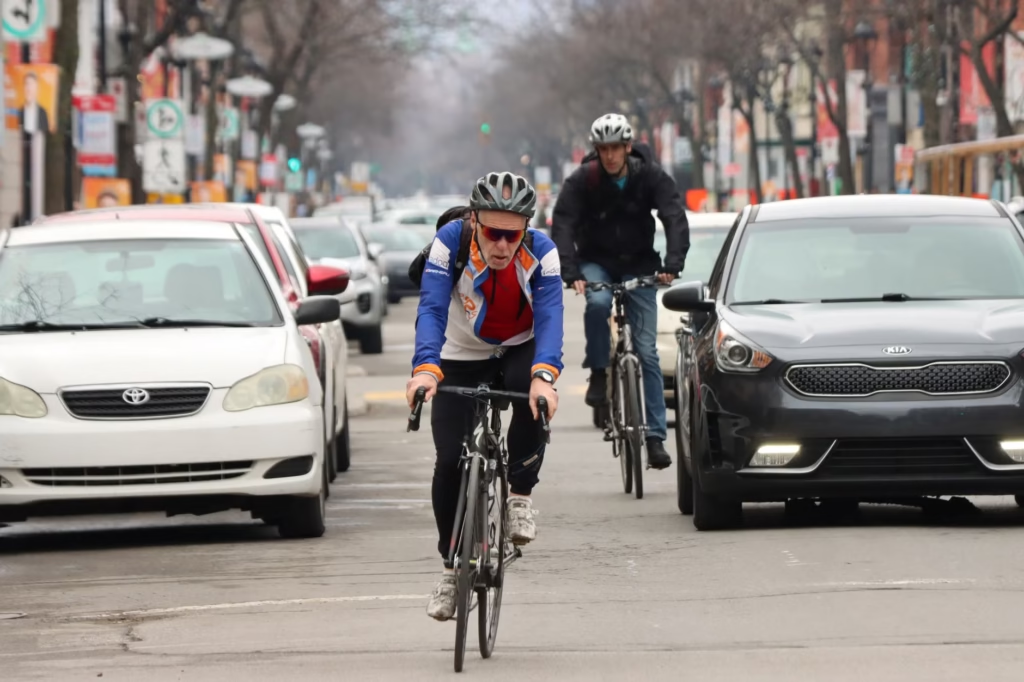
- Test the route at an off-peak time before making it a workday default. (nhtsa.gov)
- Prefer lower-traffic streets, protected lanes, and simpler intersections even if the trip is slightly longer. (nhtsa.gov)
- Use front and rear lights when visibility is poor, and do a quick pre-ride check of brakes and basic bike condition. (nhtsa.gov)
- If you choose an e-bike, practice starts, braking, and low-speed turns with assist on before commuting in dense traffic. (nhtsa.gov)
- Wear a helmet and ride predictably, obeying signs, signals, and road markings. (nhtsa.gov)
Before using an e-bike on a shared path, office campus, or park route, check the actual local or property rules. The federal product definition does not guarantee access everywhere. (cpsc.gov)
Storage, charging, and theft can settle the debate
The ride itself is only half the commuting experience. The other half is parking, carrying, charging, securing, and sometimes storing the bike in a small apartment or office. Regular bikes tend to ask less of that system. E-bikes add battery management and, depending on the model, can become awkward if the daily routine involves stairs or tight storage. CPSC’s micromobility guidance is a reminder that battery choice and charging habits are part of ownership, not an optional afterthought. (cpsc.gov)
- Can the bike be parked securely at both ends of the trip?
- If the battery must come indoors, is that routine realistic on tired days?
- If buying an e-bike, are the battery, charger, and replacement parts manufacturer-approved?
- Will the commute still feel manageable in rain, heat, or with a full work bag?
- Do building rules, transit policies, or trail rules restrict where the bike can go?
For e-bikes, use only replacement batteries tested and approved for the device, avoid modified or repurposed packs, and follow recall instructions. CPSC also says lithium batteries should not go in household trash or general recycling. (cpsc.gov)
Common mistakes that lead to the wrong choice
Most bad bike-commuter purchases are not technical errors. They are context errors. People buy for a sunny Saturday test ride, then discover that the actual commute includes a headwind bridge, office clothes, bad parking, and a 5 p.m. deadline. Or they focus on top speed when the real constraint is an unprotected intersection near work. A good commuting setup is the one that works on ordinary days, not ideal ones. (pmc.ncbi.nlm.nih.gov)
- Treating sweat as a character test instead of a transportation variable.
- Assuming an e-bike means zero exercise, which the current evidence does not support. (pmc.ncbi.nlm.nih.gov)
- Assuming a regular bike is automatically better because it is simpler, even when the route is only marginally sustainable.
- Ignoring battery provenance, charging habits, and recall history on used e-bikes. (cpsc.gov)
- Confusing higher possible speed with a better commute, even when the route itself remains uncomfortable or unsafe. (nhtsa.gov)
A practical way to choose this week
So which one is better for daily commuting? For a short, safe, fairly flat route, a regular bike is often the better answer because it is direct, active, and uncomplicated. For longer, hillier, sweat-sensitive, cargo-heavy, or time-tight routes, an e-bike is often the better answer because it makes repetition possible. If uncertainty remains, the tiebreaker is simple: choose the option you can picture using in average weather, in work clothes, on a tired Wednesday, in both directions. That is the real test. (pmc.ncbi.nlm.nih.gov)
- Map the exact route and note where traffic stress, hills, bad crossings, and delays actually happen. (nhtsa.gov)
- Score the commute-friction test honestly, not aspirationally.
- Test ride one assisted and one non-assisted option in normal clothes if possible, ideally on terrain that resembles the real route.
- Check parking, storage, and your actual battery routine before buying. (cpsc.gov)
- Buy for the hard 70 percent of days, not the easy 30 percent.
There is no universal winner because commuting is not a lab test. It is a repeated behavior shaped by route stress, clothing, time, weather, and how much daily effort transportation is allowed to demand. A regular bike remains the cleanest choice when the commute is already friendly. An e-bike becomes the better tool when it turns a borderline trip into a reliable one. The right answer is the one that gets ridden often enough to matter.
Frequently Asked Questions
Is an e-bike cheating if the goal is commuting?
No. If the alternative is a sedentary trip, e-cycling is still active transportation. The evidence suggests conventional cycling usually gives more exertion per mile, but e-bikes can still deliver moderate-intensity physical activity and may help some riders commute by bike more often. (pmc.ncbi.nlm.nih.gov)
Can a regular bike be faster door-to-door in a city?
Yes, sometimes. On short urban trips, the motor advantage can shrink once intersections, parking, and route design enter the picture. NHTSA’s route advice and FHWA’s infrastructure guidance both support the idea that route quality often matters more than raw speed. (nhtsa.gov)
What if I want fitness but do not want to arrive drenched?
That is a strong case for an e-bike or for mixing bike types. Many riders use lower assist on easy days and higher assist when heat, wind, or time pressure would otherwise make the commute unsustainable. The evidence suggests that e-cycling can still provide meaningful activity even when exertion is lower than on a regular bike. (pmc.ncbi.nlm.nih.gov)
Should a beginner start commuting on an e-bike first?
Often yes, if hills, distance, or low confidence are the main barriers. But practice matters. Assistance changes acceleration and pace, so beginners should rehearse braking, cornering, and slow-speed control before using the bike in dense traffic. (pmc.ncbi.nlm.nih.gov)
What matters most when buying a used e-bike for commuting?
Battery and charger provenance, recall status, brake condition, and whether replacement parts are approved for the device. CPSC advises against modified or repurposed battery packs, so a vague story about the battery should be treated as a serious warning sign. (cpsc.gov)
References
- U.S. Consumer Product Safety Commission – Bicycles FAQ – https://www.cpsc.gov/FAQ/Bicycles
- National Highway Traffic Safety Administration – Bicycle Safety – https://www.nhtsa.gov/road-safety/bicycle-safety
- Centers for Disease Control and Prevention – Adult Activity: An Overview – https://www.cdc.gov/physical-activity-basics/guidelines/adults.html
- Federal Highway Administration – Separated Bike Lanes – Making Roads Safer for Bicyclists – https://www.fhwa.dot.gov/innovation/innovator/issue101/page_02.html
- U.S. Consumer Product Safety Commission – Micromobility Information Center – https://www.cpsc.gov/Safety-Education/Safety-Education-Centers/Micromobility-Information-Center
- PubMed – Impact of electrically assisted bicycles on physical activity and traffic accident risk: a prospective observat – https://pubmed.ncbi.nlm.nih.gov/36249487/
- PMC – Health benefits of electrically-assisted cycling: a systematic review – https://pmc.ncbi.nlm.nih.gov/articles/PMC6249962/
- PMC – Physical activity when riding an electric assisted bicycle – https://pmc.ncbi.nlm.nih.gov/articles/PMC5406898/
- National Park Service – Electric Bicycles (e-bikes) in National Parks – https://www.nps.gov/subjects/biking/e-bikes.htm
